

Information for
Helpful Links
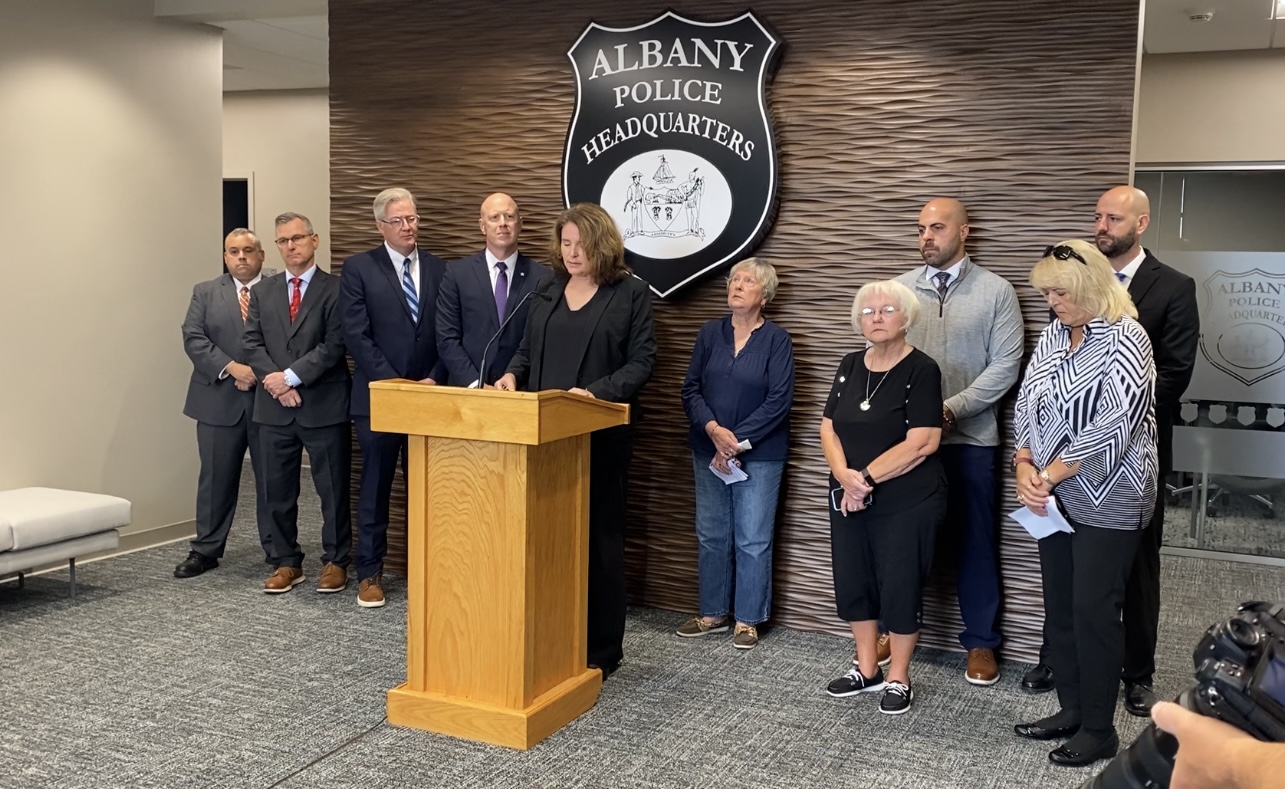
One of the first real-life unsolved cases the Criminal Investigation Resource Center Director Christina Lane ever had students work on was the murder of 50-year-old Catherine Blackburn in her Albany apartment.
Today, Lane stood with Blackburn’s family members and leaders in the Albany Police Department and Albany County District Attorney’s Office as Albany Police Department officials announced they had identified the perpetrator as Joseph Nowakowski, who died in 1998.
“In 2018, Dr. Chris Kunkle and I implemented the idea of utilizing academics with expertise in the various disciplines of investigative science and college students as a tool to assist law enforcement agencies with unresolved cases. The Albany Police Department was one of our first partners despite the massive leap of faith they would need to take by allowing civilians to have access to unsolved homicides,” she said. “The resolution of the Catherine Blackburn case is an exceptional example of years of multi-disciplinary teamwork, demonstrating that no victim is forgotten.”
In 2018, Lane and Kunkle worked with students at another college to organize unresolved case files, among them the Blackburn case. Lane, a criminologist and associate professor of criminal justice, and Kunkle, a forensic psychologist, made recommendations for using new advanced technologies to zero in on key pieces of evidence still well-preserved in the police department’s case file.
In 2024, Lane joined Russell Sage and founded the Criminal Investigation Resource Center (CIRC). The Blackburn case was one of the cases Russell Sage students continued to work on.
DNA gathered from fabric in the case file led to the exhumation of Nowakowski’s body at Albany Rural Cemetery in September, close to the time of the 61st anniversary of Blackburn’s death. They found a DNA match, allowing the Albany police to close the case.
Police said Nowakowski and Blackburn were strangers, and Nowakowski had a long criminal history before and after Blackburn’s death.
“With the center’s help, we were able to keep on keeping on,” Commander Melissa Morey, who led efforts on the case, said after the news conference.
CIRC partners with about a dozen law enforcement agencies, both local and out-of-state, to utilize students as a resource in keeping unresolved cases alive. Students, who are often criminal justice or forensic psychology majors, are held to a high standard of professionalism and confidentiality and are eligible to receive academic credit and pay for their work.
This is the second unresolved Albany Police case where Lane has been given credit for her work. In September 2024, they arrested Keri Mazzuca, who was sentenced earlier this year in the “Baby Moses” case. Mazzuca killed her infant son in 1997 and abandoned his body by the Moses monument in Albany’s Washington Park. Lane, Kunkle, and a group of students had worked on that case, prior to Lane’s arrival at Russell Sage.
The work of CIRC helps students who might be fascinated with cold cases through exposure to TV and podcasts understand the emotional impact of these unresolved missing person and homicide cases on those left behind.
Lane shared the news with the Russell Sage students who intern at CIRC before the news conference, and they were thrilled to hear Blackburn’s family would have a resolution at last.
“All of them had huge grins and pride being part of something that does make a difference and helps so many other families, and it’s in the area that interests them and they want to have a career in,” she said. “Many of them, because of the center, they want to become law enforcement or even victim advocates because of their experiences. So they are just glowing.”
News coverage on the Blackburn case: