

Information for
Helpful Links
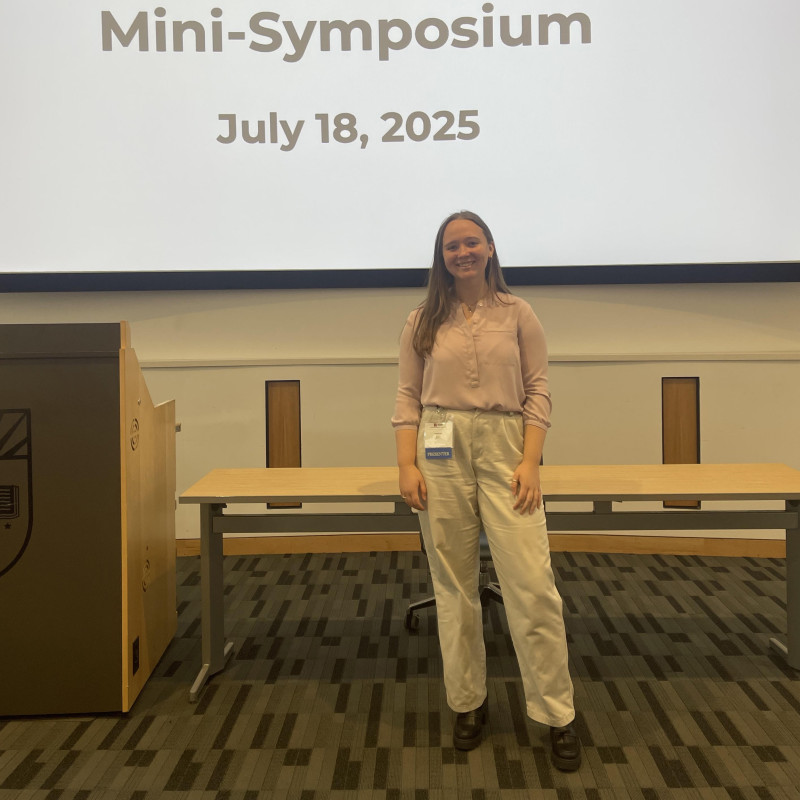
Russell Sage College Biology major Elizabeth Hoyt spent summer 2025 contributing to research that examined the mechanical properties of blood clots — essentially, how firm, flexible, or fragile they are — and how certain proteins might cause clotting failures that lead to dangerous bleeding or stroke. The larger project could help doctors prevent and treat these medical events.
She found the opportunity in a cellular bioengineering lab at Rutgers University through the National Science Foundation’s Research Experience for Undergraduates, a highly-selective summer program which supports cutting-edge laboratory experiences on campuses across the country.
“I was definitely very nervous before starting the program,” Hoyt said, acknowledging that biomedical engineering was a new area to her. She quickly realized how well-prepared she was, thanks to Sage.
“My anatomy and physiology and immunology classes gave me an introduction to the blood clotting process and proteins involved. My physics class gave me an introduction to topics like force and tension, and my lab experiences at Sage prepared me for tasks such as pipetting and notetaking.”
Hoyt, who will graduate from Russell Sage in December 2025, added that being accepted into the research program was also a vote of confidence as she begins applications for a doctorate in cellular and molecular biology.
“At our program orientation, the director explained that only 27 participants were chosen out of 1,377 applicants, a 2.8% acceptance rate,” she said. “The Research Experience for Undergraduates in Cellular Bioengineering on my resume tells graduate schools that not only was I motivated to find an opportunity like this, but also that my credentials were good enough to be accepted.”
While Hoyt has decided to pursue a Ph.D. in anticipation of a career in cancer research, she also considered a doctorate in physical therapy and medical school, and chose Russell Sage because its Biology program would allow her to explore these different tracks without falling behind.
“I also have come to love the small class sizes and personal connections I’ve made with faculty,” she said. “I gave a 20-minute oral presentation at last year’s Undergraduate Research Day, and most of the biology department attended. That feeling of community and appreciation amongst the Sage faculty is one reason why I’ve enjoyed my academic journey here so much.”