

Information for
Helpful Links
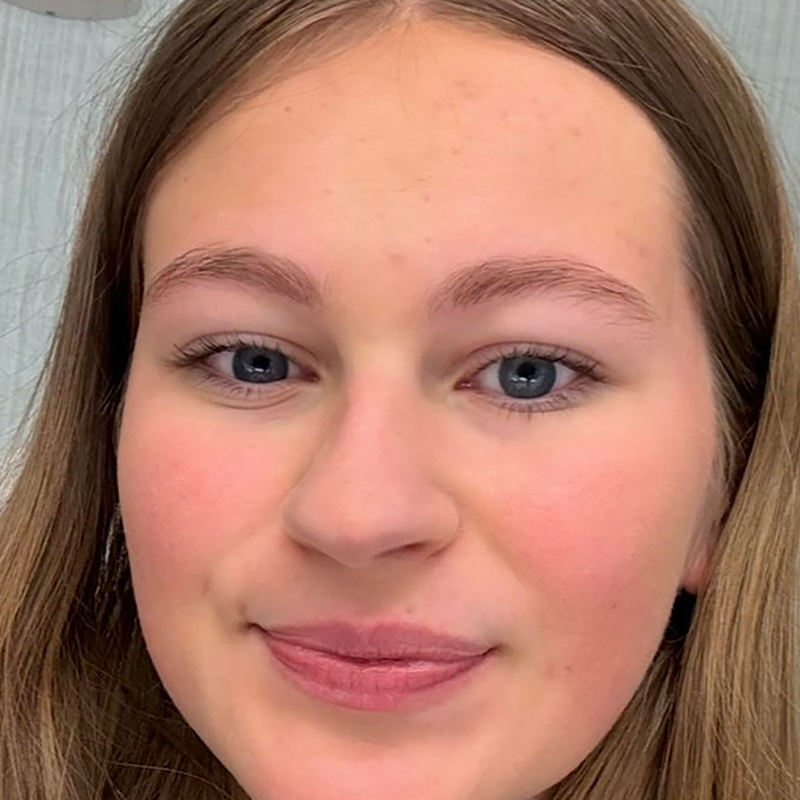
Natalie McGlauflin ’28
When transfer student Natalie McGlauflin was looking for a place to continue her studies in communications sciences, Russell Sage College’s Speech Language Pathology degree program stood out for its small class sizes and the way it carried forward the reputation and impact of the program at The College of Saint Rose, which closed in recent years.
In this Q&A, McGlauflin shares what drew her to the field and how early hands-on experiences — like service learning at the Aphasia Center — are inspiring her goals as a future clinician.
What attracted you to a speech-language major?
I was attracted to a speech-language major because of the wide range of opportunities for future work! As a child, I worked with a speech-language pathologist, so that also led me to want to work in the field. Additionally, I was able to shadow a school SLP, and saw how rewarding of a career it is. Being able to help someone find their voice is just amazing. I also was very interested in how communication works through all the neurological processes.
What attracted you to Russell Sage for your degree?
I started at another college as undecided, then chose a linguistics major. When I came to Sage, I was technically switching majors, but still in the same field. Sage made the process super easy! It was free to apply, I did not need a personal essay, and I got a decision very quickly! They worked with me for scheduling and financial aid, and everything overall was a smooth transition.
I was attracted to Russell Sage because of the small class sizes and the establishment of the Saint Rose program, in which Sage took over. It is the only college in proximity to my house that offers a speech-language pathology program. I joined a Zoom call before transferring, in which professors in the program explained courses that would be offered. This really showed me how much potential there would be to grow my knowledge, and the professors seemed extremely knowledgeable and helpful.
What have been some of the highlights of your experience in the Speech Language Pathology Bachelor’s Program?
The biggest highlight so far has been my service learning course. This course required us to participate in sessions at the Aphasia Center on Sage’s Albany campus. We were able to interview a client who receives treatment at the center. This experience expanded my understanding of how versatile speech-language pathology is. The work was vastly different from what I had seen in school settings. Through this, I was able to connect information I was learning in my traditional class, about communication disorders, to real-life situations. I was able to learn strategies to use when communicating with someone who has aphasia in my class, and then actually put them into use at the Aphasia Center. Additionally, I was able to learn about another communication disorder — primary progressive apraxia of speech. Without my service learning course, I may not have ever interacted with anyone with this condition, as it is extremely rare.
Why should others consider a speech-language major?
Others should consider a speech-language Pathology major because it is a rewarding career, with lots of support systems, and lots of different options you can take post-education. You can work with people of all ages and in many different settings. The faculty in the Speech Language Pathology program at Sage have been amazing and really have made this major even better.
What kind of work would you like to do as a speech-language pathologist?
Before I started the program, I thought I would definitely work with younger people, but after my experiences at the Aphasia Center, I am not so sure anymore! The Aphasia Center has shifted me into liking that clientele as well. I am sure, throughout graduate school, I will be able to experience more settings and find out what I like the best.
Please tell me about anything else that is enhancing your experience at Russell Sage.
The environment at Sage has enhanced my experience. When it was warmer, I would sit outside and do my work, and it was just peaceful and quiet. Additionally, my classmates have enhanced my experience. We all quickly got along well. The professor I had, Dr. DeBonis, as well as Julie Hart at The Aphasia Center have been absolutely wonderful, as well.