

Information for
Helpful Links
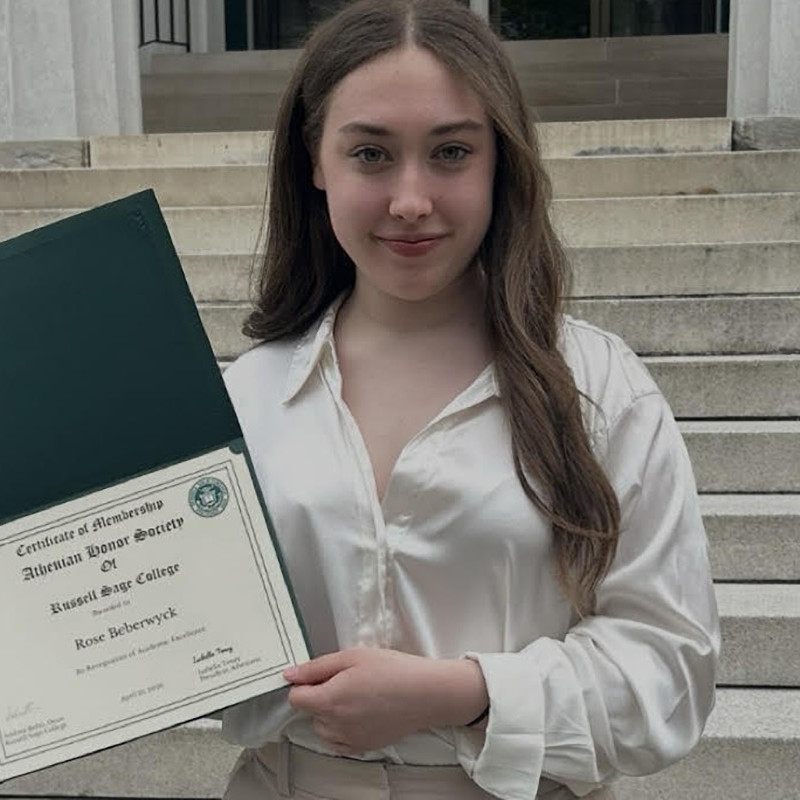
Russell Sage College Psychology major Rose Beberwyck is examining how coping styles impact psychological well-being to better support gender and sexual minority populations in mental health settings.
She recently spoke with Professor of Spanish and Honors Program Director Kate Kagan about how hands-on opportunities like conference presentations and internships have helped her connect her college experience to her career goals.
You’ll be presenting at the New York State Association for Foreign Language Teachers conference. Tell us about your presentation and what you’re most looking forward to about this experience.
My presentation will be on the research behind minority stress, psychological well-being, and coping in the transgender and gender diverse population. This research is preceding an ongoing study of mine examining how each of these variables interact — specifically, how coping style may mediate the relationship between minority stress and psychological well-being. I’m looking forward to seeing the work presented by my peers and getting the opportunity to share my own with them! I’m curious to see what connections we can draw between our topics.
You’re also conducting research based on a survey related to your future career. What inspired you to explore this topic, and what have you learned so far?
In my future career, I hope to work in mental health care, especially with the underserved population of gender and sexual minorities. In choosing my research topic, I wanted to study something that I felt could make a contribution to the quality of care provided to this population. My hope is that the results of my research will help inform the coping skills taught to transgender and gender diverse clients in therapeutic settings.
How do you think your research experience will help you in your future career? Are there any skills or insights you’ve gained that you think will be especially useful?
I think this research experience will not only be relevant in terms of applying the results to the skills I teach, but also to understanding the lived experiences and needs of clients from this population. Learning about the many forms minority stress can take and the associations between exposure to such stressors and various psychological outcomes has been, and will continue to be, incredibly insightful.
How can your research help you better understand the needs of the community and find ways to get involved? Do you see opportunities to use what you’re learning to make a difference beyond the classroom?
My biggest motivation in my research is to improve the quality of mental health care of gender and sexual minorities. I believe that learning about how different coping skills are associated with psychological well-being helps accomplish this by informing practitioners on the unique needs and strengths of this group! I hope that my research not only contributes to knowledge, but also appears in practice in the future.
Looking back on your experience at Russell Sage, what opportunities have helped you grow the most, and what advice would you give other students who are interested in research, conference presentations, or exploring their future careers?
The opportunities that allowed me to flourish the most in my education have been conducting research and my internship at AR Mental Health. Both came with a sense of independence as I became responsible for applying what I’d learned in the classroom to the real world, and they made me feel very connected to the field I wish to work in.
My advice for fellow students is to reach out and take initiative! The best opportunities have not just fallen into my hands — I had to seek them out myself and be determined to make them work, even when it wasn’t easy. Never hesitate to reach out for help from professors and other professionals, either! I’ve found them to always be happy to help, and they have been a great support for me in my journey.