
Information for
Helpful Links
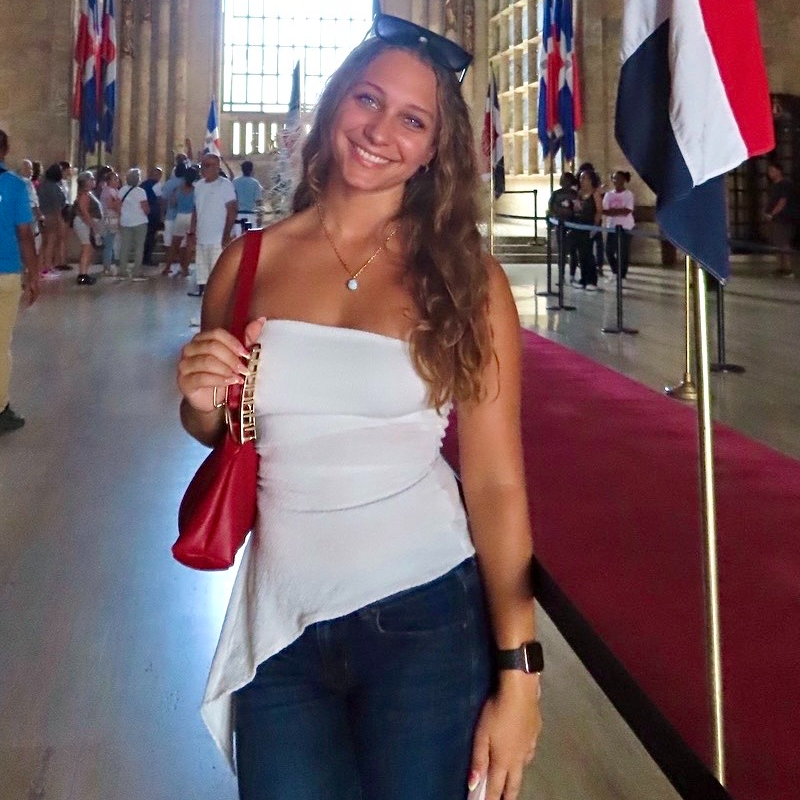
Education major Jacqueline Rock-Perez turned her study abroad experience in the Dominican Republic into a conference presentation about the correlation between extracurricular programs and positive social and academic outcomes. She shared her findings at the New York State Association for Foreign Language Teachers conference, which led her to some exciting future possibilities.
She recently spoke with Professor of Spanish and Honors Program Director Kate Kagan about how her research and study abroad experiences strengthened her Spanish fluency, deepened her connection to her heritage, and prepared her as a language educator.
As a transfer student majoring in Education with a concentration in Spanish, how have you found your place at Sage, and what opportunities have helped you grow the most?
I found my place at Sage by joining many clubs, including serving as president of the Russell Sage Dance Team and as an RA on the Albany campus. In these positions, I have been able to connect with students, faculty, and staff to help make Russell Sage a more inclusive and welcoming campus for everyone. I’ve had many opportunities to grow as a student, including fieldwork for my classes at elementary schools, participation in professional development and honors events, and leadership roles on both campuses.
You’ve presented your work at several conferences, most recently the NYS Association for Foreign Language Teachers conference. What did you present, and what was the most exciting part of sharing your work with others?
I presented my poster titled, “Building Resilience through Art: Addressing Educational and Social Needs in Cienfuegos, Dominican Republic.” As I studied abroad in the Dominican Republic in the fall of 2025, I partnered with a school in Cienfuegos, Santiago, to offer extracurricular educational programs for elementary students with limited resources. In addition to providing lunches, we concluded the semester with a collaborative mural project, featuring student artwork selected by vote and painted on the building’s exterior.
My goal was to observe the students’ academic and social progression, and I found a positive correlation between participation in these activities and improved academic and social outcomes. The most valuable part of sharing this experience was to see how this project could be impactful to students everywhere. With a more individualized approach, students can succeed more in and outside of the classroom. I even had the opportunity to meet with a professor from the American Association of Teachers of Spanish and Portuguese as well as a member of the hiring committee of the Council of International Education Exchange (CIEE) and was offered job opportunities by both of them after sharing my research.
How did your semester abroad change your perspective on language, culture, and your future as a Spanish educator?
My semester in Santiago, Dominican Republic, transformed my perspective on language and culture while deepening my connection to my heritage and my father’s roots. Full immersion in Dominican life significantly strengthened my Spanish fluency and helped me appreciate how language bridges diverse communities. Living with a host family for four months enabled me to communicate effortlessly in Spanish, while also helping me recognize distinct regional dialects. As a future Spanish educator, I am eager to bring these experiences into the classroom, encourage my students to embrace cultural awareness, and highlight how intercultural communication fosters global connection and understanding.
You have been invited to an internship connected to another study abroad program in Spain. What does this opportunity involve, and how will it help you develop as an educator, if you decide to go?
This opportunity involves teaching English and Spanish to international students participating in a Spanish-English language program in Spain. Beyond refining my Spanish fluency, it offers valuable hands-on experience as a Spanish language educator. Additionally, given my interest in teaching English as a New Language, this program allows me to teach both languages to a global student body while fully immersing myself in Spain’s rich cultural landscape.
What would you say to other students, especially those who may not think of themselves as researchers, about getting involved in research, presenting at conferences, or pursuing study abroad opportunities?
My primary advice is that the possibilities are endless if you are willing to step outside your comfort zone. When The College of Saint Rose closed, I was devastated and unmotivated as a transfer student. However, I used that hardship to propel myself forward and pursue my dream of visiting the Dominican Republic so I could converse with my father and family in their native language.
Initially, adjusting to Russell Sage was challenging. Getting involved in campus activities helped me build meaningful connections and turn the college into a true home. Driven by a passion for helping people in less fortunate communities, I centered my research on topics I genuinely cared about, which made presenting at professional conferences both seamless and exciting.
I highly encourage any student to explore study abroad opportunities. Immersing yourself in a new country and culture expands your horizons, creates lifelong friendships, and offers a life-changing perspective. Mastering another language unlocks opportunities in virtually any field, deepens your appreciation for the world, and allows you to connect with people and places in ways you never thought possible.
I am deeply grateful to CIEE, Russell Sage College, my host mother, and my family and friends for supporting my dream of studying in the Dominican Republic — a place that I am now proud to call home.