

Information for
Helpful Links
Like many of us, Assistant Professor of Occupational Therapy Chris Mulligan often turns to music — especially 90’s hip-hop or Zac Brown — to boost energy or relieve stress.
Music is such an uplifting part of her own routine that she began to use it to enhance her classroom culture. Now, she is formally studying the effects of music on exam performance.
Mulligan teaches anatomy, kinesiology, and physical rehabilitation classes in Russell Sage College’s Master of Science in Occupational Therapy and Doctor of Occupational Therapy programs, and she guides doctoral research.
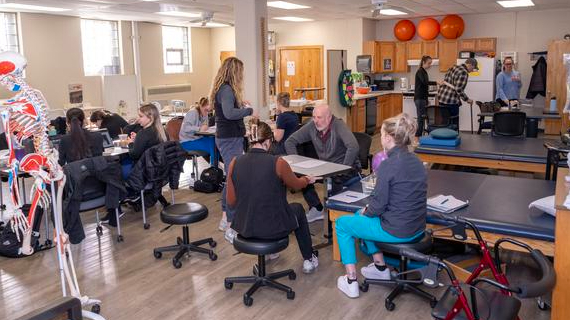
For a few years now, she has let students choose music to play in the background during lab sessions while they learn diagnostic and treatment techniques from palpation to splinting. The music helps mitigate the “after-lunch slump” during afternoon labs, she said, and also mimics the background noise that students will encounter in professional practice.
Music seemed to make a difference in her classroom, so she took it a step further. “I wanted to see if I played music in the background during a practical, if it would relieve any of the stress and anxiety that the students have,” Mulligan said of her research into the effects of music on stress levels and performance during practical exams, published in the Journal of Occupational Therapy Education in 2024.
Lab practical exams — or “practicals,” as they are called informally — are a routine but nerve-racking part of a graduate degree in Occupational Therapy.
A typical practical involves a pair of lab partners in a room with an instructor. The students draw cards that create a random scenario a practicing OT is likely to encounter, and take turns addressing the set of circumstances assigned in the scenarios while the instructor assesses their performance in an otherwise quiet room. Most classes include two practicals a semester, around midterm and finals weeks.
With students’ consent and Institutional Review Board approval (IRBs protect the rights of research subjects), Mulligan and colleagues measured students’ blood pressure, heart rate, and other indicators of anxiety before and after practicals in December 2021 and June and November 2023. The researchers compared the stress response of students in a silent exam room with that of students in a room with 60 beats-per-minute music playing in the background.
“I looked at the literature that shows what kind of music reduces anxiety and I found that 60 beats per minute is good,” Mulligan said, adding that Spotify has playlists based on beats per minute, which she used to build her “practical playlist” of songs students would recognize. Her playlist included songs like “Thinking Out Loud” by Ed Sheeran and “Memories” by Maroon 5.
“I did find that there was a significance in a reduction of the systolic blood pressure in the students that had music versus those who did not,” Mulligan continued. She’s reviewing the data to see if the lowered stress response correlates with more successful exam performance and will submit her findings to the Journal of Occupational Therapy Education.
Mulligan collaborated with Assistant Professor of Occupational Therapy Bonnie Fischer-Camara and Lecturer Marybeth Hoefs on the study, with input from Associate Psychology Professor Donald Graves. Associate Professor of Occupational Therapy Leslie Bennett and recent OTD graduate Sam Rivera were instrumental in data collection.
Their inquiry into the effects of music on stress and performance during practicals is consistent with Russell Sage College’s commitments to student success and student well-being and Mulligan is already considering how to build on their findings.
“I might try a different stress reduction strategy, like diaphragmatic breathing, or let students choose their own music,” she said of future research directions.