

Information for
Helpful Links
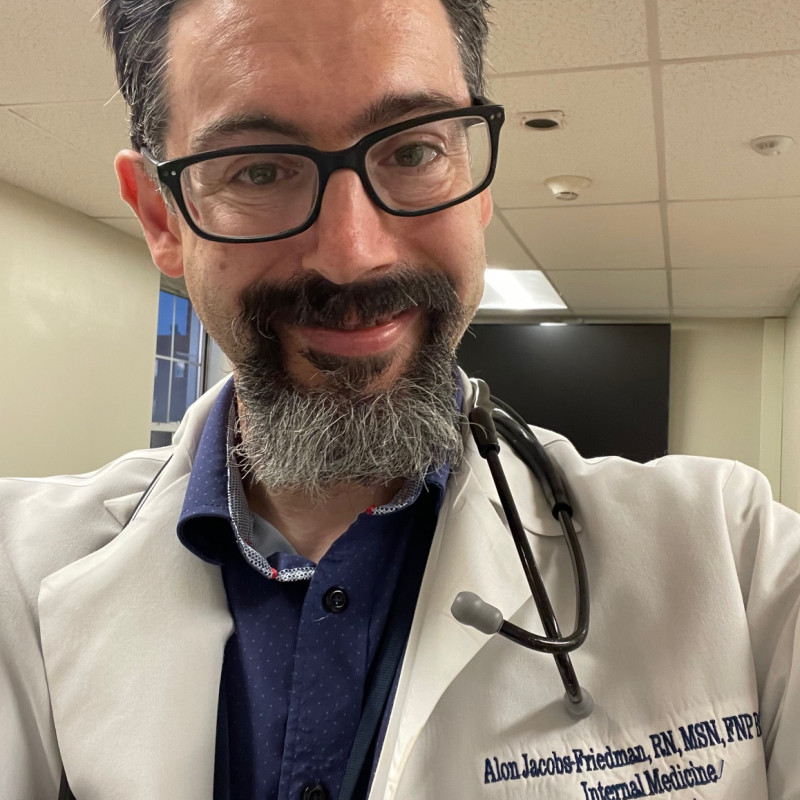
Alon Jacobs-Friedman has been caring for patients at Albany Medical Center since 2004, first as a registered nurse and now as a Family Nurse Practitioner. In 2015, he earned his master’s degree in nursing at Russell Sage College, which allowed him to advance into the NP role. He recently returned to Sage for a Doctor of Nursing Practice, which he’ll complete in 2026.
Below, he describes his inspiration for a career in advanced practice nursing and what made Sage’s DNP program worth waiting for.
As Alon worked with vascular, cardiac, med-surg, hospice, and renal transplant patients as a registered nurse, he found himself drawn to the why, not just the what. That deeper clinical thinking is central to the NP role, where identifying underlying causes is part of everyday practice. In his own words:
“I had a moment on the transplant unit when I figured out what was going on with a patient, and the doctor said, ‘You diagnosed this patient, you figured this out.’ That was my catalyst to become a nurse practitioner.
Why I feel so passionate about being a nurse practitioner is the blending of the art of nursing with the science of medicine to create a role with a foot in both worlds. It’s taking all of the advocacy, empathy, compassion, caring, and communication that we do as bedside nurses and blending them with all of the science and diagnostics that a physician or PA would get. You end up with a very distinct method of practice, and I think, some advantages.
One thing I consistently see is that communication with NPs tends to be substantially better. As a nurse, you really learn the art of bedside communication, and with a good rapport, you often get some tiny piece of information that the patient gives up that completely changes what you would be doing.”
“I’m an overnight hospitalist, and it works very well for me, but there will come a day when I don’t want to stay up all night. I wanted to set myself up to be able to do remote practice and also teach. Both of those pair very well with the doctorate degree.
For three years, I’ve been a preceptor for Certified Registered Nurse Anesthetist students who do an acute care rotation. I love teaching. I say this tongue-in-cheek: At some point, I’ll need good people to take care of me, so this is my way of trying to give back to Sage what the program gave to me.”
Alon found Sage’s M.S. in nursing ideal for someone working full-time, which encouraged him to return for his DNP.
“For me, it had to be a DNP specifically — a degree built around clinical excellence and practice improvement, not just credentials. I wanted training that would make me a better clinician, not just add letters after my name. For a long time, Sage only had a DNS program, so I held out for the DNP program to come into being.
If you’re independent and motivated but also very busy, Sage offers a level of flexibility that doesn’t exist anywhere else, at least not locally. You can go at your own pace, which is essential when you’re balancing a demanding clinical schedule.”
And the faculty?
“The faculty aren’t just instructors — Several of them were my professors during my FNP program, and some are or have been colleagues at Albany Med. There’s a continuity and depth of relationship you don’t get elsewhere. These are seasoned clinicians with decades of experience who genuinely invest in student success.”
“If you’re already a bedside nurse, I would say shadow with a couple of different NPs, because it’s really a whole other ballgame. You’re seeing more people sequentially but having a greater influence and advocacy with their care.
Whereas the bedside nurse might spend several days recovering a post-operative patient, doing what I do overnight, instead of having to make a call and get an order to fix them, I can actually just fix it. I can correct the problem.
Now, as an overnight hospitalist, I’m often the one patients see when something goes wrong at 3 AM. Being able to assess, diagnose, and act — not just call someone else — that’s the culmination of everything nursing and advanced practice has taught me. And eventually, I’d like to bring that same approach to psychiatric care through telehealth, helping patients in a different way while passing on what I’ve learned to the next generation.
To teach the perfect blend of the art of nursing with the science of medicine — that’s the legacy I want to leave.”