
Information for
Helpful Links
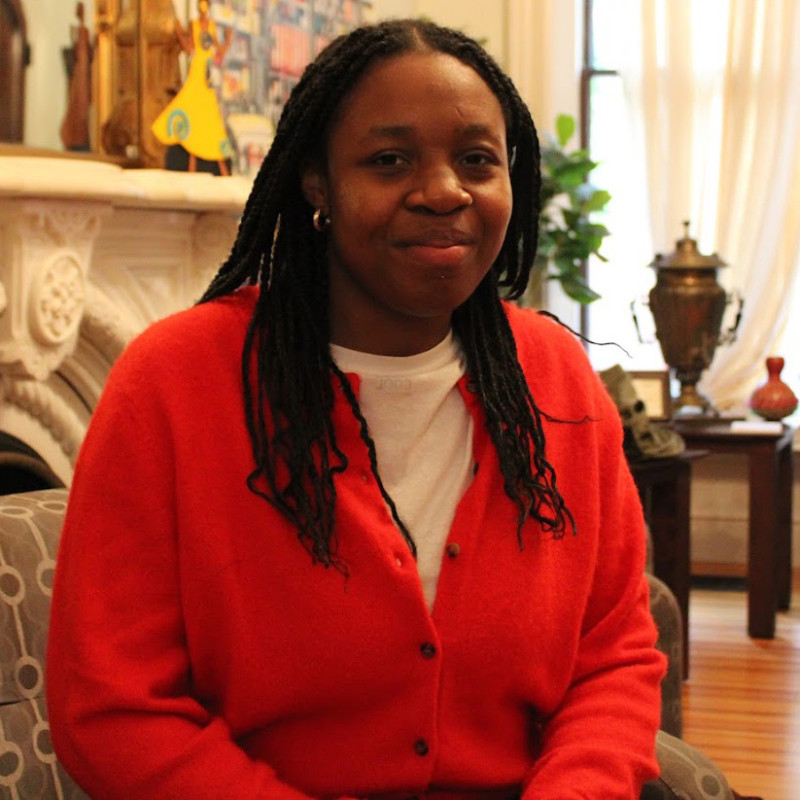
Russell Sage College Biology major Bridelle Toumani has presented her research at multiple conferences, in a variety of disciplines.
She recently spoke with Professor of Spanish and Honors Program Director Kate Kagan about exploring the humanities as a STEM student, gaining confidence as a presenter, and how service learning shaped her latest research project.
You’re a Biology major, but your research and conference experiences have taken you into different fields and settings. How did you become interested in research outside of your major?
I think that being a naturally inquisitive person who is interested in many disciplines is what has gotten me to do research outside of my major.
I may be a Biology major who takes difficult STEM classes like Organic Chemistry and Microbiology, but I also like to read literature and explore museums and learn about the culture we live in more and more each day. Getting a Bachelor of Science doesn’t change that. If anything, it fuels me to explore the humanities whenever I have my free time.
Your first conference presentation at the Northeast Conference on the Teaching of Foreign Languages (NECTFL) came from an Honors Humanities course on Spanish history.
What made you interested in taking that course, and what was it like to take something you studied in a Humanities class and turn it into research that you presented at a conference?
I was drawn to the Honors Spanish course because of its unconventional approach to teaching Spanish history. The idea of learning about the country through fiction and other forms of media sounded way too cool and fresh to not consider. I genuinely loved the course so much. I enjoyed the short stories, the films, and authors that we encountered throughout the semester (and I added to my To Be Read list!)
It was the discussion of the conflicts and shifts in Spanish history that played a big part in my topic selection for my NECTFL research poster. The Spanish-American War is often a blip in both the canon of Spanish history and the canon of American history, and is traditionally discussed in a very unnuanced way, where it is talked about in completely binary ideas — for example, it was a complete embarrassment for Spain and a victory lap for America. It felt really empowering to create a poster that completely flips that idea and presents a new narrative.
Since then, you’ve presented at the New York Capital Region Honors Exchange (NYCHE) and will be presenting at New York State Association for Foreign Language Teachers (NYSAFLT) and the New York Six Undergraduate Research Conference.
How has your experience as a presenter changed from that first conference to where you are now?
The first conference made me really nervous, unsurprisingly. It was a very new experience for me, and I was not anticipating the questions I got, many from experts in the field of Spanish culture. It was an overall positive experience, and my people skills are far better now.
Has being an Honors student changed the way you approach questions, research, or even your own interests?
Yes, absolutely. The Honors courses I have taken truly force you to think bigger, which I really appreciate and is something I plan to take with me even after I graduate.
Your upcoming presentation on interactive read-alouds and elementary oral language development comes from your service-learning experience in Russell Sage’s signature class, Innovating to Impact.
What did you learn from connecting a class with an experience outside the classroom, and how did that experience turn into something you wanted to present?
I’ve learned that it is a bit tricky to combine research with personal experiences from service projects, and yet it makes the poster feel more whole and personal.
I have enjoyed the past few weeks of my service sessions, where I get to see, in real time, young students develop a close and personal relationship with reading. I really want to present my experience with volunteering so that, hopefully, reading to youth isn’t underestimated. Maybe, hopefully, it becomes more revered.
Looking at everything you’ve done so far, what has surprised you most about becoming a student researcher? And what would you say to another Sage student who is interested in research or presenting but doesn’t think they are ready yet?
I think what has surprised me the most about being a student-researcher is how effortless many parts of the writing/presenting process can feel, especially when the topic you have dedicated yourself to means so much to you and feels like yours in a sense.
I recommend that students interested in research write down topics of interest that come to mind and let trusted professors in about them. They will inevitably steer you in the right direction to make the paper come to fruition. From there, it’s as easy as pie!