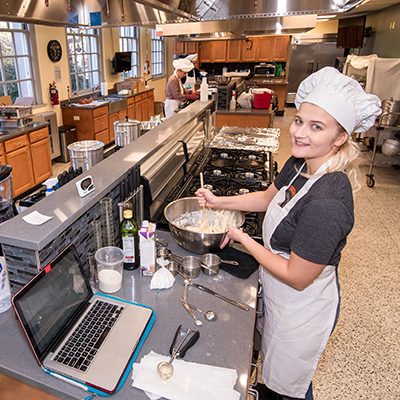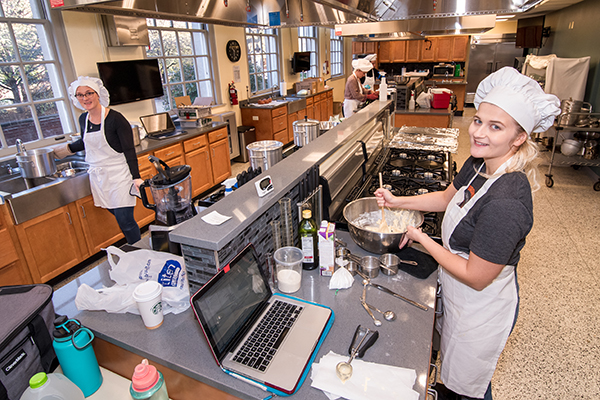
Dietetic Interns Michelle Walker (left) and Katie Walczuk (right), pictured in Sage's Manor Nutrition Science Lab, catered the Interprofessional Education Forum with food donated by the Honest Weight Food Co-op.

Become an Authority on Nutrition

With a Nutrition and Dietetics degree, you’ll be prepared to pursue the RDN credential and work in health care, public health, education, research or private practice.

Specialties in our Nutrition & Dietetics master’s program

A Russell Sage nutrition degree means something in the field:

We are a top-three producer of nutrition degrees and certificates in New York state. We are the ONLY accredited nutrition program in New York’s greater Capital Region. Many employers look for a Sage-educated RDN above all others.

Students engage in research that supports community wellness efforts, like a recent project to help the United Way of the Greater Capital Region’s Summer Meals Collaborative ensure it is meeting local children’s needs.

The Hannaford Nutrition and Physical Assessment Lab and the Manor Nutrition Sciences Lab are equipped with advanced research tools.

Our experts are tapped for research on issues like child wellness in Troy, New York.

  • Hybrid convenience: Taught in a hybrid format of online and in-person classes, you’ll learn everything you need to take you to the next level.
  • We’ll put you on the path to become an RDN: With a master’s degree in Nutrition and Dietetics and a Dietetic Internship, you can sit for the exam necessary to become an RDN — even if your undergraduate degree is in an area other than nutrition.
  • We are a leader in population health efforts: Department-sponsored events, like our annual lecture with CDPHP, are a major source of community health information.
  • Official transcripts from all post-secondary institutions attended
  • Two letters of recommendation
  • A 1- to 2-page career goals essay: We want to hear your voice. Russell Sage College values authenticity, critical thinking, and personal expression. We ask that all application essays be written solely by the applicant with only ethical use of AI technology, such as tools that support but do not generate content.
  • A resume
  • An RSC graduate school application
  • GRE scores are not required

Best Class Ever: Nutrition and Dietetics: Farm to Family Wheels

Leah Waldron ’25
Nutrition & Dietetics, M.S.

Course Requirements

Credits and Completion

This is a 45-credit course of study that combines graduate-level ACEND-accredited Didactic Program in Dietetics (DPD) courses with master’s courses.

Full-time students may complete the program in as few as three semesters, while part-time students may complete the program at their own pace.  Additional prerequisite courses may apply.

Course Objectives

  • research analysis and interpretation
  • writing, communication and professional presentation
  • critical thinking
  • ability to evaluate the effectiveness of nutrition interventions
  • medical nutrition therapy
  • confidence using evidence-based guidelines in practice

The M.S. in Nutrition and Dietetics program is built around five major content areas:

  • nutrition science
  • dietetics
  • research
  • public health
  • nutrition communication

Taught in a hybrid format of online and in-person classes, you’ll learn everything you need to take you to the next level.

Personal advising, experienced faculty

Our nutrition and dietetics master’s comes with a deep, Russell Sage-level of support from an assigned faculty advisor who works with you to ensure your success.

“We get to deliver a rigorous, competitive science-based Nutrition and Dietetics degree, but we get to do it in small classes.””

Sonya Hauser, Ph.D.
Associate Professor of Nutrition Science
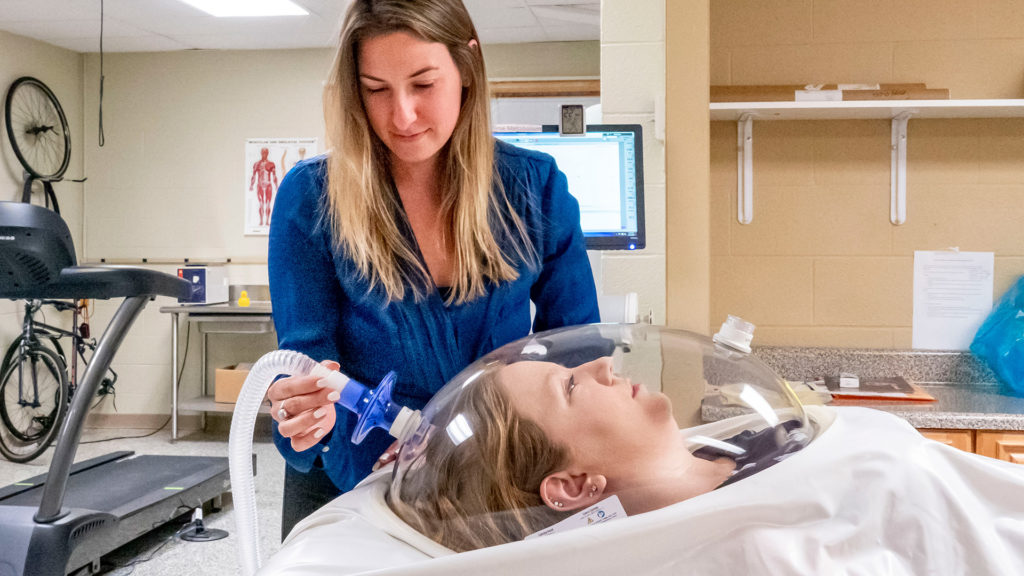
RSC nutrition student in the lab

Your Future Career with a Master’s in Nutrition & Dietetics 

Professionals with a Nutrition and Dietetics degree pursue Dietetic Internships and the RDN credential and work in medical centers, sports nutrition and corporate wellness programs, community and public health settings, and universities and research settings.

Alumni of Sage’s Nutrition and Dietetics degree program work at Community Care Physicians, Cornell Cooperative Extension, hospitals and in New York State’s Women, Infants and Children programs.

Dietetic Internship Program

After completing your master’s in Nutrition and Dietetics, you’ll be eligible to apply for an accredited Dietetic Internship program. Many students go on to pursue Russell Sage College’s Dietetic Internship program.

You’ll get a minimum of 1,200 hours of supervised practice, preparing you to take the next step: passing the CDR’s dietetic registration exam.

Frequently Asked Questions – M.S. in Nutrition and Dietetics

A. Registered dieticians work in a range of environments, including healthcare and corporate environments. According to the U.S. Bureau of Labor Statistics (BLS), as of 2024, 26% of dieticians and nutritionists work in hospitals, while 12% are self-employed, 11% work in government settings, 9% work in nursing and residential care facilities, and 7% work in outpatient care centers.[1]

Evidence indicates that the roles available to registered dietitians are expanding beyond typical settings. For instance, the RAND Workplace Wellness Programs Study found that more than half of workplaces with more than 50 employees offer some kind of wellness program.[2] Coupled with the fact that McKinsey indicates the wellness industry as a whole is worth more than $2 trillion globally and that functional nutrition is a growing sector of the wellness industry, these trends suggest that more opportunities are likely to open up for those who are educated in nutrition and passionate about pursuing that career field in the coming years.[3]


A. Artificial intelligence (AI) is being used to make nutrition and meal planning more efficient and more effective for individuals as well as nutrition professionals. For example, the Journal of American Nutrition and Dietetics[1] published a study in 2024 where a machine learning model was used to analyze the food diaries of participants who wanted to lose weight and control their diabetes. The AI model was able to predict which participants would lose weight based on the nutritional content of their food diaries, indicating that “AI has the potential to expand the ability for digital health to personalize coaching and insights towards better health outcomes.”

Although nutrition experts are largely enthusiastic about AI’s ability to help them and their clients make meal plans, find recipes, and make healthier choices, some concerns still exist. According to Janice MacLeod, a registered dietitian nutritionist, AI chatbots “are still not quite accurate” and require an expert to oversee the results to ensure that client plans are safe, effective, and evidence-based.[2]


A. Yes, graduates of a nutrition and dietetics program who earn RDN certifications can certainly pursue roles in entrepreneurship or private consulting. According to the BLS, as of 2024, 11% of dieticians and nutritionists were self-employed. A 2024 report published by the Academy of Nutrition and Dietetics showed that 8% of RDNs are entrepreneurs are engaged in consultation, business, and industry.[1]

RDNs in private practice may start their own consulting businesses, or they may partner with other health professionals, such as personal trainers, physicians, or even sports organizations to provide nutrition and meal planning services. RDNs interested in entrepreneurship beyond working with clients should be prepared to innovate in the areas of software, nutritional supplementation, and even artificial intelligence as it relates to diet and nutrition.


A. Dieticians collaborate with fitness and healthcare teams in a range of ways, including providing meal plans customized to client needs and goals. According to the Academy of Nutrition and Dietetics, the need for RDNs to collaborate with other professionals through interprofessional practice is  expected to increase in coming years. The Academy notes, “The necessity of Registered Dietitian Nutritionists (RDNs) and Nutrition and Dietetic Technicians, Registered (NDTRs) in interprofessional practice will be accelerated by Food is Medicine, a philosophy grounded in preventive medicine and disease management that strongly connects nutrition and healthcare for better patient outcomes.”[1]

Even the thorough training that medical doctors receive rarely includes robust nutritional information, leaving patients without access to evidence-based nutritional advice. By working alongside care teams in a variety of settings, RDNs can use their training to help improve the health of many different populations, depending on their own professional and personal goals.


A. The most in-demand subspecialties in dietetics right now include the following:

  • Public health[1] – According to the University of Ohio, “The United States Department of Agriculture (USDA) recognizes that achieving nutrition security is a cornerstone of public health. Dietitians will be at the forefront of this critical effort.”
  • Disease management – Dieticians specializing in renal nutrition, oncology nutrition, and diabetes care are expected to be demand.
  • Telehealth consultation[2] – As more practices expand their telehealth offerings to reach a broader range of clientele, dieticians who can practice remotely will be in more demand.
  • Pediatric dietetics – The rise in childhood obesity and health issues means that the demand for pediatric specialists is growing.

Registered dieticians can choose to earn specialized certifications from different specialty organizations, including the Commission on Dietetic Registration, the Certification Board for Diabetes Care and Education, or the National Board of Nutrition Support Certification.[3]


Need help?
Associate Professor of Nutrition
518-244-2047

Take the Next Step

It's time to take the next step. Choose yours below.