

Information for
Helpful Links
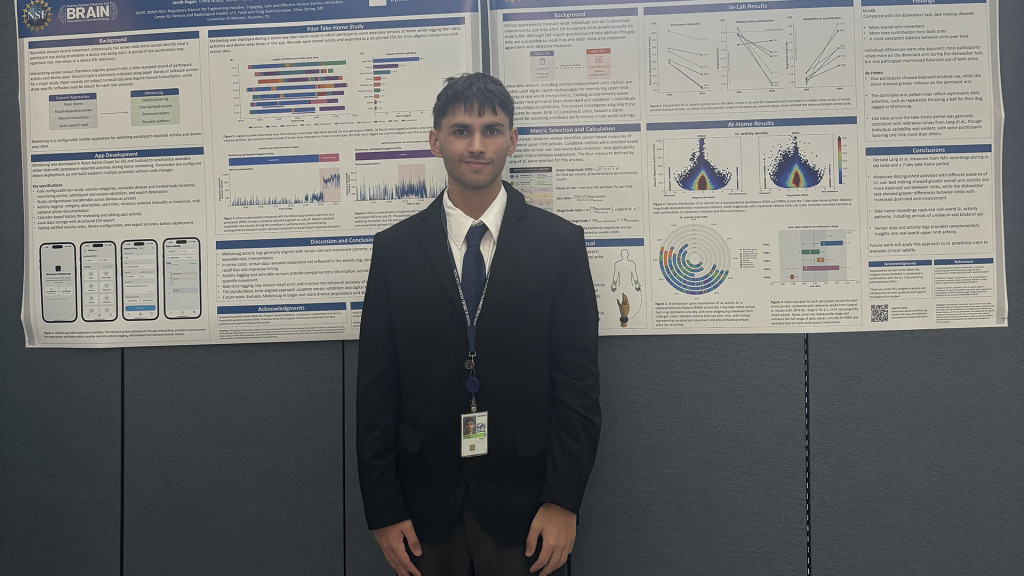
Innovating Medical Tech: His work focused on building software and a mobile app to measure how participants use their arms in everyday life using wrist-sensor data. He helped run the study, collecting data and analyzing the results. This work could help researchers better understand how upper limb prostheses perform outside of clinical testing.
Russell Sage Preparation and Leadership: In addition to serving as Pre-Health Club President, Jacob prepared for his fellowship through self-taught coding, volunteering at Sage’s Aphasia Center, and presenting at seven undergraduate conferences during his first year.
This summer, Jacob Kagan ’27, a Biology Honors student and Pre-Health club president at Russell Sage College, participated in the highly-selective National Science Foundation (NSF) Research Experiences for Undergraduates (REU) fellowship program.
The opportunity sent Kagan to the University of Houston’s IUCRC BRAIN Center and the U.S. Food and Drug Administration (FDA) in Maryland, where he contributed to two projects aimed at providing data on arm movement to help advance clinical research and medical device development.
In the following Q&A, Kagan shares how combining self-taught coding skills, volunteering at Sage’s Aphasia Center, and presenting at several conferences while an undergrad prepared him to work with university and federal research teams to connect technology with patient care.
I spent the summer in an NSF-funded REU fellowship through the IUCRC BRAIN Center, Building Reliable Advances and Innovation in Neurotechnology, at the Cullen College of Engineering at the University of Houston. I also conducted research at the FDA in Maryland through the Center for Devices and Radiological Health.
I had two projects, both working toward developing a digitally derived endpoint that measures how people actually use their arms in everyday life. Clinical assessments can tell us what a person is capable of doing in a controlled setting, but not how they function at home and in the community. For the first project, I built software that takes raw wrist sensor data and turns it into objective measures of arm use. For the second, I developed a mobile app that lets participants record what they were doing and when they were wearing their devices, which gives us the context needed to make sense of the sensor data. The app could eventually be used as a regulatory science tool at the FDA.
I also helped run a full-body biomechanics study, collecting data from participants in the lab and analyzing the upper-limb portion of the data for my projects.
The long-term goal is to help researchers, clinicians, and regulators better understand how medical devices, including upper limb prostheses, perform in people’s everyday lives rather than only during clinical testing.
Most of the technical experience I brought to the fellowship was something I developed independently. I started coding in middle school, teaching myself Swift and Objective-C to build iOS software, and kept building those skills over the years.
During my fellowship, I worked with a range of biomechanical data collection equipment. I also had experience from my other research and healthcare work, including behavioral observation, human data collection, and laboratory research. Even so, I had to learn new techniques and skills while working alongside Ph.D. students, biomedical engineers, neuroscientists, and other researchers.
Sage contributed to my experience in important ways. I have volunteered at the Aphasia Center since 2024, when I was still in high school. That experience helped me better understand the human side of neurological and communication disorders. It also gave me early clinical experience that helped me qualify for and pursue several clinical positions. Each new opportunity gave me more experience, and this early involvement allowed me to take on greater responsibilities in patient care and research at a young age.
I have also had opportunities to present my work and research interests at conferences. During my first year of college, I presented at seven conferences, including regional and national undergraduate conferences, which helped me develop my communication and presentation skills.
At the University of Houston, one of my favorite parts was seeing the variety of neurotechnology being developed. I enjoyed learning from neuroscientists, engineers, and researchers working on devices for conditions like Parkinson’s disease, cerebral palsy, and stroke. One of the most memorable things I saw was technology involving exoskeletons and brain-controlled movement designed to help people who had lost mobility after a stroke.
At the FDA, one of the biggest highlights was seeing how research can connect directly to medical device regulation and real-world patient outcomes. I also learned more about the scientific and engineering work involved in evaluating medical technology.
Outside of the lab, I had valuable networking opportunities. I met professionals from biomedical and technology-related organizations and learned about different career paths.
I want to continue working in healthcare and science, and I am exploring different graduate and professional opportunities.
This research experience helped me realize that there are many different ways to combine medicine, technology, research, and patient care.
This experience gave me a broader range of skills and experiences to draw from as I pursue opportunities after graduation. I worked in both an R1 engineering lab and a federal research environment while gaining experience with programming, wearable sensors, biomedical research,software development, and regulatory science.
More importantly, I was able to see the process from developing technology and analyzing data to considering how that technology could eventually be evaluated and used in the real world.
I think that combination of my research experience with my clinical experience has also given me a better understanding of how healthcare technology connects to the people it is ultimately meant to help.
I encourage other students to look for opportunities like research fellowships, internships, and conferences. A lot of opportunities are more accessible than students realize, and sometimes the biggest step is simply applying or reaching out.
As president of the Pre-Health Club, I hope to help other students discover opportunities in research, healthcare, fellowships, and professional development that they might not otherwise know about. My experience this summer showed me how valuable it can be to step outside your normal academic environment, meet new people, and explore career paths that you may not have considered before.