

Information for
Helpful Links
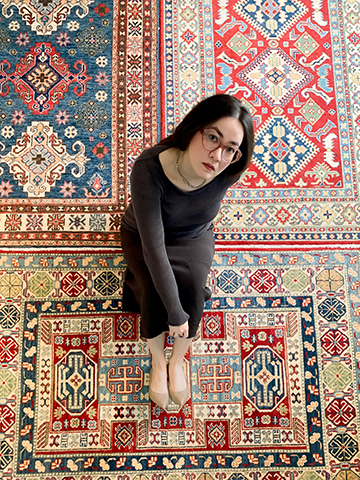
Russell Sage College graduate Hajar Hussaini ’19 has won a 2026 Whiting Award for Emerging Writers, which includes a $50,000 prize. Whiting Awards are presented annually to 10 writers in fiction, nonfiction, poetry, and drama, and recognize accomplishment and promise.
Hussaini is the author of Disbound: Poems and two forthcoming translations: a collection of poems by Maral Taheri and the novel Death and His Brother by Khosraw Mani, both originally published in Persian.
The award selection process is highly confidential, and Hussaini was unaware she was being considered. She learned about her award when the Whiting Foundation sent a follow-up email after the initial message landed in her Spam folder.
“I was completely shocked,” she said. “I had no idea. I didn’t know what to do. I didn’t have a panic attack, but it felt like a panic attack.”
The judges described her work as “a marvel of poetic architecture. … Her poems exemplify how mere fragments can contain the entirety of times, places, and people we thought lost. Defiant, they refuse to equate that loss with erasure.”
Hussaini grew up in Kabul, Afghanistan, before earning a bachelor’s degree in English, Writing, and Culture (formerly Writing and Contemporary Thought) from Russell Sage and an MFA in Poetry from the Iowa Writers’ Workshop.
She is currently at work on a series of epistolary poems addressed to a future resident of Afghanistan after the fall of the present Taliban regime. “These poems are about a new beginning and imagining a new possibility for Afghanistan, or, essentially, trying to stay hopeful,” she said. “It’s a way for me to think about another kind of future that is informed by the past.”
The Whiting Award is the latest recognition for Hussaini, whose other recent honors include a MacDowell Fellowship, a PEN/Heim Translation Fund Grant, and the Mo Habib Translation Prize.
An assistant teaching professor at Skidmore College, Hussaini said she draws on lessons from her Russell Sage professors in her work with college students.
She remembers being particularly inspired when Professor Maureen Gokey shared her own projects with students and makes it a point to do the same.
She also remains close to former lecturer Matthew Klane, with whom she organizes the Salon Salvage poetry reading series in Troy, and who she describes as having a profound influence on her development as a poet.
“He’s really good at destabilizing what you think is poetry,” she said. “He’s always challenging the norm of poetic language, and that was really helpful for me growing up, to see that there are endless possibilities.”
Hussaini returns to Russell Sage regularly, most recently in March, when she spoke with students in a first-year seminar.
“I talked about a lot of things, but one of the things was this idea of a reinvention of the self,” Hussaini said. “And afterwards, some students stopped to talk about this idea further. It was really sweet to just be in a conversation with someone I was in the past in a way, because I see myself in those students.”
“Russell Sage has been such a home for me,” she continued. “Part of the reason I’m here is because of the scholarship I had at Russell Sage. And I’m forever grateful for all those professors who taught me so much.”