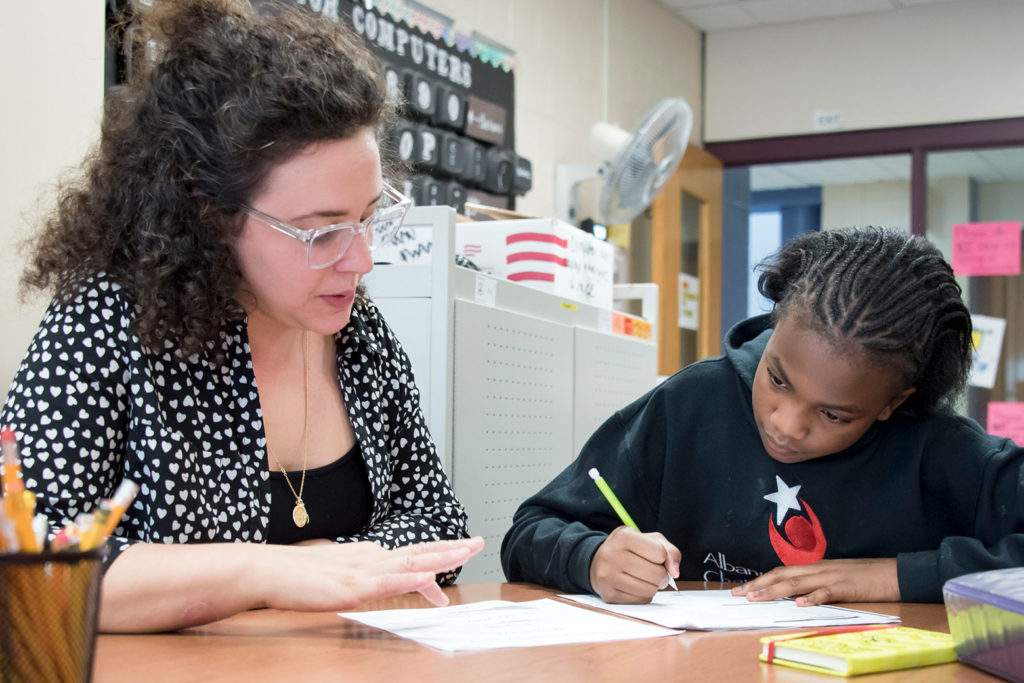
Education degree candidate and elementary student

Become a Literacy Specialist for all Grades

Graduates of this master’s program in literacy education become literacy specialists — the experts who share best practices with general education colleagues and provide direct instruction to small groups of learners who struggle with reading and writing.

Program Distinctions

You’ll build skills to teach face-to-face and in a digital format. Become broadly versed in knowledge and strategies for teaching all types of students and learn how to develop instructional plans for at-risk learners.

This master’s in Literacy Education program, part of the Esteves School of Education, is accredited by the Association for Advancing Quality in Educator Preparation (AAQEP).

You’ll learn practices that emphasize evidence-based teaching, differentiated instruction, diversity and inclusion, teaching English language learners, and teacher reflection.

Courses draw on the “new literacies” lens to integrate technology into innovative and traditional learning activities.

You’ll complete at least 50 hours teaching at-risk, diverse, urban learners online and face-to-face. Faculty believe that the best learning happens in clinically rich contexts, making local public and charter schools the perfect opportunity for you to develop your skills.

  • After you complete the master’s in Literacy Education, you’ll be eligible to take the Content Specialty Test required to become a literacy specialist.
  • Applicants should have initial teacher certification in Childhood Education or be eligible for initial certification. Individuals without certification, please see our Childhood Education/Literacy Specialist program. 
  • If you are interested in dual certification, please see Russell Sage’s master’s in Special Education and Literacy.

The Power in Positive Education

Well-being matters, and today’s students and teachers need the tools to manage today’s world. 

Upstate Living Interview with Dr. Steven Hoff and Education Students Aaliyah and Jada: Hear from Dr. Steven Hoff how positive education helps teachers and students build resilience, feel a sense of belonging and mattering, and create classroom environments where students can thrive academically and personally. Russell Sage students Aaliyah and Jada also share how their experiences studying education are helping them bring positivity, wellness and gratitude into their future classrooms.

“Russell Sage College and the Esteves School of Education act as leaders in education, not just in the Capital District but in New York State.”

Peter Stapleton, Ph.D.
Assistant Professor of Education
  • Official transcripts from all post-secondary institutions attended
  • Two letters of recommendation
  • A 1- to 2-page career goals essay: We want to hear your voice. Russell Sage College values authenticity, critical thinking, and personal expression. We ask that all application essays be written solely by the applicant with only ethical use of AI technology, such as tools that support but do not generate content.
  • Current resume

Program Objectives

  • Evaluate, diagnose, interpret and teach students with significant difficulties in reading and writing
  • Are prepared to work closely with diverse families and other educators to provide targeted, excellent literacy instruction
  • Provide ongoing professional development to other educators and parents
  • Use data (including individual, classroom and schoolwide data) to inform instructional decisions
  • Are highly effective in collaborating with others
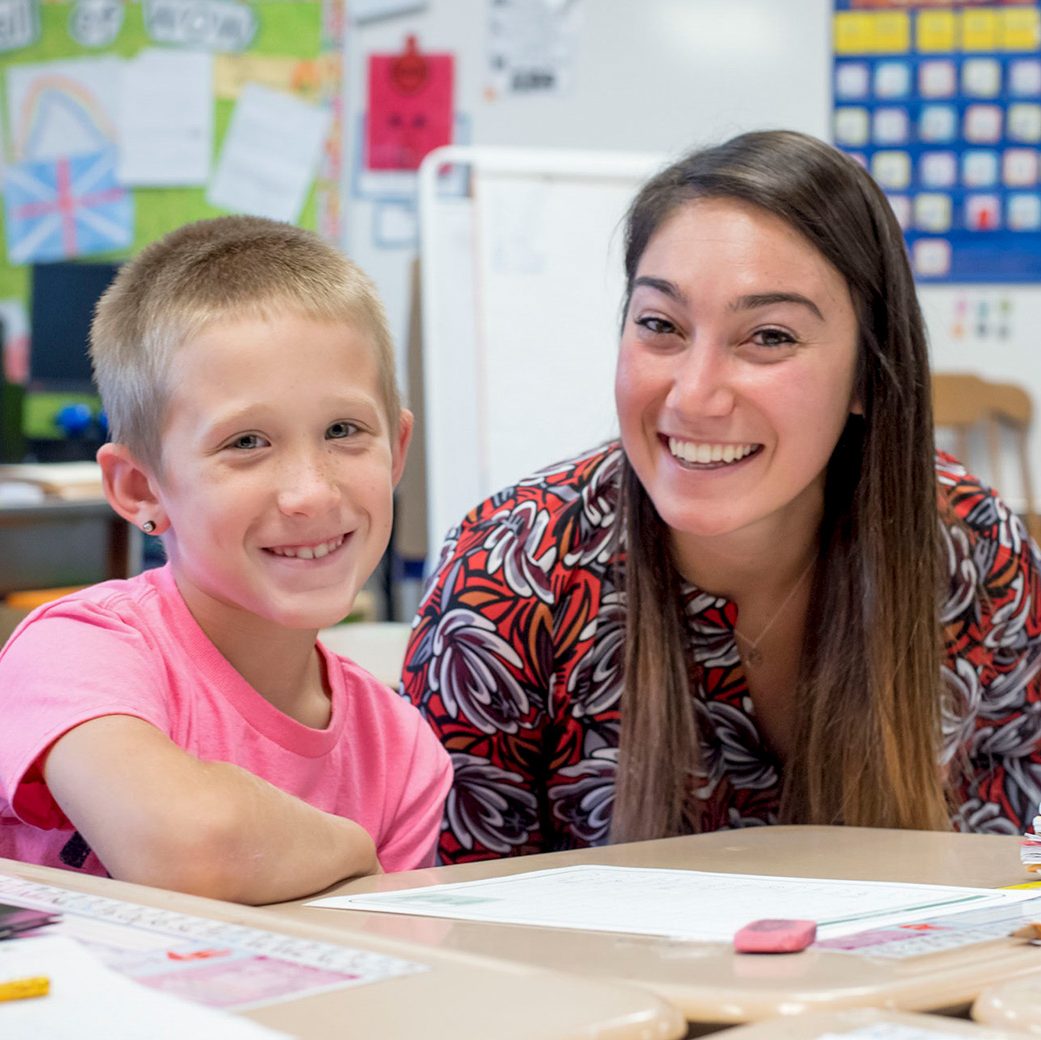
child and student teacher in elementary classroom.

Careers with an MSEd in Literacy Education

Graduates often work as classroom teachers with advanced knowledge in teaching reading and writing to at-risk learners or become literacy specialists at the elementary or secondary level.

Take the Next Step

It's time to take the next step. Choose yours below.