

Information for
Helpful Links
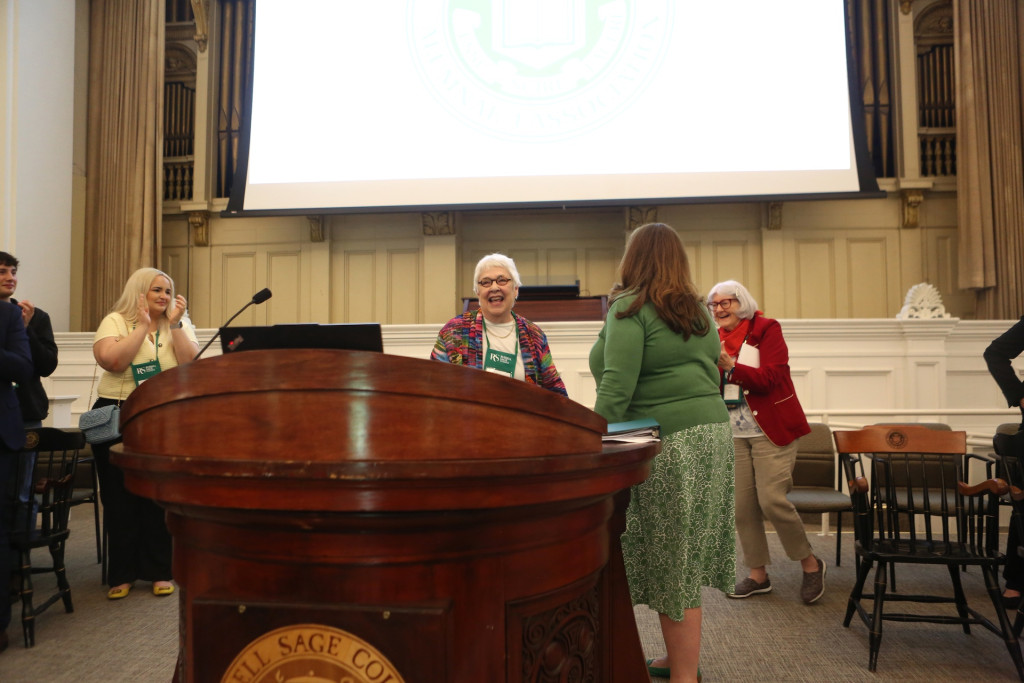
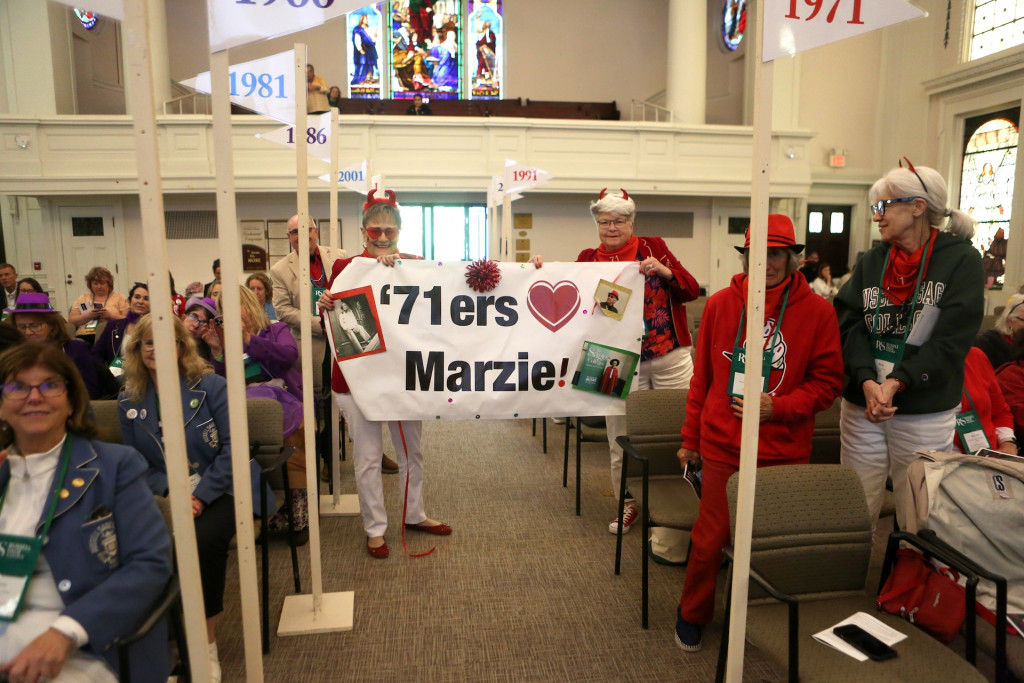
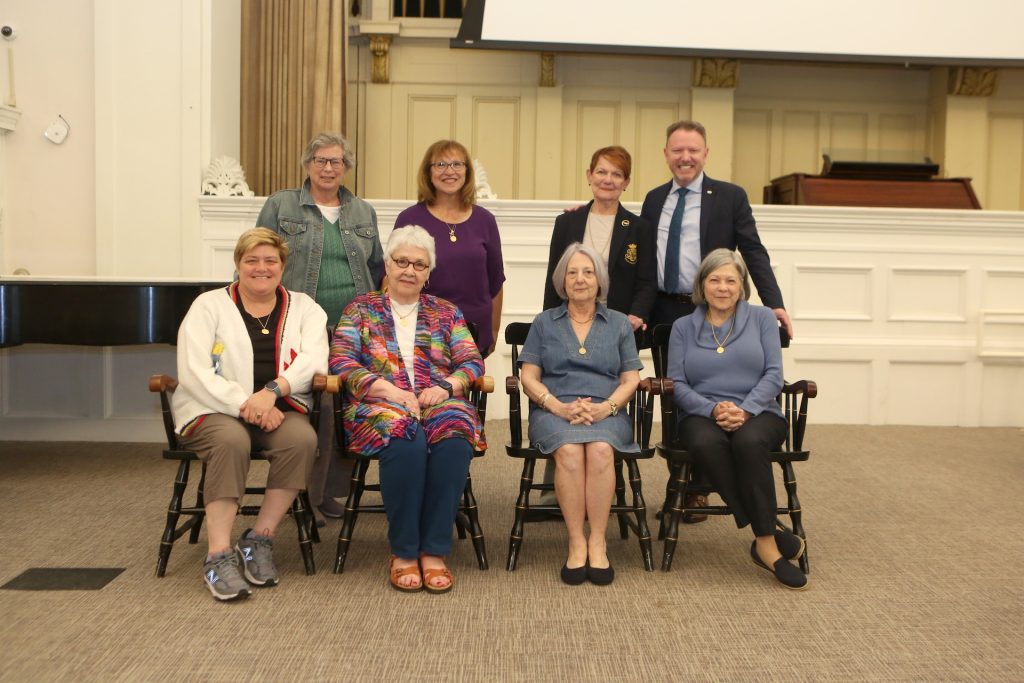
Mary Altpeter ’71, Ph.D. is a changemaker. That is the consensus among the Russell Sage College alumnae who nominated her for the 2026 Doris L. Crockett Medal, the Russell Sage College Alumnae/i Association’s highest honor.
They describe her as a “force of nature,” who has a rare gift for putting people at ease, listening deeply, and forging instant, genuine connections. Whether she is discussing the nuances of global health or simply sharing a kind word, they say she has a knack for spreading gratitude and congeniality, leaving colleagues across all generations and medical disciplines feeling a profound sense of pride in their work.
The Crockett Medal recognizes both personal and professional contributions. Altpeter’s nominators proudly pointed to her 40-year career as a social worker, administrator, research scientist, educator, and champion for public health. Trained in social work, gerontology, and public administration, she’s now retired as a research associate at the Thurston Arthritis Research Center at UNC-Chapel Hill.
Along the way, she consulted for international organizations like the European Union, the Pan American Health Organization, and the Fulbright Faculty Exchange program, delivered over 150 presentations worldwide, and helped design and test the Arthritis Foundation’s “Walk With Ease” program. Her work in aging earned her numerous prestigious state, association and research journal awards, including being named a Fellow of the Gerontological Society of America.
Even while managing her demanding career at UNC, Altpeter gave her time to Russell Sage, serving from 2015 to 2019 on the Russell Sage College Board of Trustees and as a member of the Alumnae/i Association Board of Directors. After her term ended, Altpeter was tapped to help build the Advisory Board for what is now known as the Denise Taber Finard ’80 Women’s Institute at Russell Sage, where she still serves today.
Deeply respected by her peers in the Class of 1971, who affectionately refer to her as “Marzie.” She is celebrated by her nominators as the ultimate definition of “alum goals” for the way she lives the Russell Sage College motto: Be. Know, Do.” A nominator stated, “She exemplifies what we want all Sage students and graduates to be. She is curious, inquisitive, aggressive in her search for knowledge, a life-long learner, and generous in sharing what she has learned and acquired.”
We sat down with Altpeter during Reunion Weekend to talk about her incredible career, her memories of Russell Sage, and her impressions of where the college is today.
What originally brought you to Russell Sage?
Altpeter: Originally, I was going to be a physical therapy major. At that time, the science coursework came easily to me, but the clinical patient relationships were a different story. Brand new, and with absolutely no preparation, I was sent into a clinic and assigned to a teenage boy who had become quadriplegic from an accident. As you can imagine, he was extremely upset, and I had no skills to deal with his depression and anger. It scared the daylights out of me. And I thought, “I don’t think I can do this.”
But because science was fun for me, I decided I’ll be a science major. At the time, Sage offered a wonderful major called “natural sciences divisional,” which was essentially code for people who liked science but didn’t quite know what they wanted to do with it yet. I took biology, chemistry, and physics. I got to dabble, which was a great way to explore my interests.
You mentioned that coming back for your 40th reunion was a major turning point that caused you to reinvest in Russell Sage. Why?
Altpeter: There’s a backstory and context to that question. I grew up in the 1950s and ’60s. During those formative years, messages I heard about women’s roles were: “Be a lady … Be sweet … Don’t have an opinion … Don’t rock the boat… Let the man make the decisions … Don’t be too smart. Men don’t like smart women.”
Then I came to Sage in the ’60s, and I had the incredible luck of having the chair of the science department, Dr. Bob Gehrig, as my academic adviser. He totally changed that “script” of docile subservience. Instead, he told me, “You have the academic potential to go to graduate school. When there, you can focus on your specific area of interest and career goals. While at Sage, take advantage of a liberal arts education. Take courses that interest you or maybe even scare you. I’ll support your course choices.”
In that mentoring, he activated my curiosity, encouraged me to form opinions, take charge of my potential, and inspired me to dream about what my future could be. Over the years, I came to appreciate how transformative his mentoring was. In that vein, at my 40th reunion, I began contemplating how I might “pay it forward” – helping to promote transformative experiences for students to find themselves and set the course for their educational journeys and careers.
After leaving Russell Sage, how did you navigate graduate studies, and how did your education at the college prepare you?
Altpeter: Basically, I learned study skills and developed the pure enjoyment of learning at Sage. For my senior thesis, I studied psychotropic medications for schizophrenia because Dr. Gehrig had encouraged me to take elective courses in the social sciences where I could explore the interface between the psychological and physical. This thesis project prompted my interest in graduate study in mental health, so I then applied to the University at Albany School of Social Welfare.
I had asked our then-dean of freshmen, Dean Flaherty, to be a reference. Apparently, she talked with the dean on my behalf. Evidently, he told her, “We’ve never had a science major as a student.” I don’t know what discussion ensued, but by the time Dean Flaherty was done, I was awarded a two-year National Institute of Mental Health (NIMH) fellowship! When your faculty, staff, and administrators go to those lengths to invest in and advocate for you, it says, “You’re worth it. You can do it.” They built up my preparation and confidence to be a graduate student.
Your career trajectory is fascinating – you went from an MSW to an MPA and eventually earned a Ph.D. in your 40s. What drove you to keep pushing?
Altpeter: I’m devoted to lifelong learning and lucky to have had timely opportunities. After I obtained my MSW, I worked in social work clinical services and continuing education and then became a mid-level manager in state service. My state bargaining unit offered a tuition-free, six-course graduate certificate in public administration. I completed those six courses and applied those toward the 12-course MPA program. I’m delighted to see that Sage is likewise using this same certificate-to-degree channeling model.
Later, I was managing and writing research grants at UNC Chapel Hill but couldn’t be listed as the principal investigator, as I was only prepared at the master’s level. I thought if I’m going to pursue a Ph.D., I want an international adventure. The Ph.D. in social work research at Memorial University in Newfoundland, Canada, catered to “seasoned” professionals, 10 years post-master’s. We were encouraged to be creative in designing electives tailored to our individual interests. What was also compelling about the program was its format – while we attended summer courses on campus, we could take courses online or on local campuses during the rest of the year. This enabled me to take advantage of other academic resources and to keep my regular job while I completed the program. Convenient and adaptable programs like this one provide crucial support for those contemplating advanced degrees.
You served as an alumna trustee on the college’s board of trustees from 2015 to 2019, which you noted was an incredibly tumultuous and historic time for the college. What was that experience like?
Altpeter: It could not have been a more difficult time for me. I worried whether we would be able to stay afloat, and I also struggled particularly about the loss of the women’s college, which had been so important in my early years. But then-President Chris Ames presented the concept of the Women’s Institute to continue Sage’s legacy of advocacy for women’s empowerment and education. We were so lucky to have Chris Ames and Rick (Vice President for Finance Rick Barthelmas), who were rock stars for how they managed the college’s finances. There were other champions, too, including trustees and the faculty and staff who were incredibly loyal, making salary and retirement support sacrifices to grit it out with us as we reinstated financial stability.
What led you to transition your focus to the Women’s Institute Advisory Board?
Altpeter: As an alumni trustee, my term was “four and done.” I was asked to come back to the board, but my heart was anchored in supporting the legacy of the Women’s Institute. As I’ve already explained, my mentor’s influence and my academic experience at Sage were instrumental in setting the stage for my graduate education and career. I wanted to focus on women’s empowerment and transformative mentoring, paying it forward to current and future generations. While our societal norms about gender equity have advanced, there’s still many explicit and tacit biases that women encounter.
Looking at Russell Sage College today, what excites you most about its current direction?
Altpeter: There’s a long list! The merger with Albany College of Pharmacy and Health Sciences will result in our becoming a premier regional health sciences institution, and we’re ready to achieve university status. I’m excited about all the new programming, such as the Institute for Positive Education, the Criminal Investigation Resource Center, the expansion of dramatic arts and arts management, and the Women@Work leadership credential. There are so many opportunities for experiential learning.
I’m thrilled that the vision for the Women’s Institute has become operationalized and firmly entrenched within the college programming. I’m also excited about the generous support and endowment we’ve received for the Denise Taber Finard Women’s Institute, and more recently, for the newly installed art gallery. I also am inspired about the Women’s Institute ambassadors. They are so engaged in developing leadership skills for self-growth and for serving all kinds of communities. It’s rather heartening and inspiring to watch these students and the Women’s Institute grow and flourish!