

Information for
Helpful Links
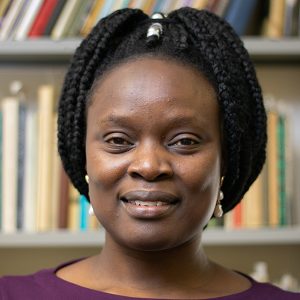
A new grant from the Glenn W. Bailey Foundation will support a project designed to help students in Russell Sage College’s nursing bachelor’s program understand why certain entry-level math and science courses are required, and how those courses relate to nursing careers.
Associate Professor of Chemistry Emilly Obuya, Ph.D., Ed.D., is leading a team of faculty and academic advisors to improve how prerequisite coursework prepares students for nursing courses. The goal is to make sure students build essential skills coherently, rather than encountering them in isolated assignments that don’t clearly connect.
For example, many nursing students learn the same mathematical process in more than one course, but in different ways and without clear coordination, said Obuya, explaining that the same process could be referred to as “dimensional analysis” in CHEM-103: Intro to Chemistry and “conversion factor method” in MATH 104: Math for the Professions.
As a result, students may not always realize that they are building on prior knowledge or understand how that foundational knowledge applies to nursing responsibilities, such as calculating medication dosages.
Obuya’s project focuses on improving coordination across prerequisite courses so students recognize foundational skills and concepts they’ve encountered before, and understand how they will use them in nursing.
“We’re trying to have career-connected learning, right from the start,” said Obuya.
By including academic support staff, the project will also help identify where students struggle most often, and use that information to shape tutoring, advising, and other academic support services.
It’s very aligned with Russell Sage’s Student First ethos, Obuya said. “It’s about what we are doing collectively as an institution — not just me as a chemistry professor, you as a nursing professor — but how are we working together to ensure student success?”
“And then we map that out,” she continued, “so that every student is able to see, this is why I’m taking this course. This is what I’m being asked to do for this exam, this is how it connects to this other course, and this is how it’s going to lead me into my nursing program.”
Obuya has received significant grant funding for previous projects aimed at advancing sustainable community-centered water purification solutions, and more recently, for research examining systemic inequities in STEM education and developing pathways that expand access to high-demand STEM careers.
To strengthen her educational research, she added a doctorate in Educational Leadership to her doctorate in Chemistry. She earned her Ed.D. in Russell Sage’s Esteves School of Education with assistance from the Gut Endowed Chemistry Award Fund, which provides professional development funds to faculty from the department of Chemistry, Physics & Mathematics.
“This is the first project that I’m doing as a freshly-minted social science researcher, and I’m glad this first project is giving back to the college in a way that will help the Student First effort,” she said.
While Obuya’s initial focus is on nursing, she anticipates this project will also inform how Sage’s other health and professional programs are structured and supported. “What are we doing for health sciences? What are we doing for nutrition?” she asked. “I would be interested in expanding this research into other areas.”