

Information for
Helpful Links
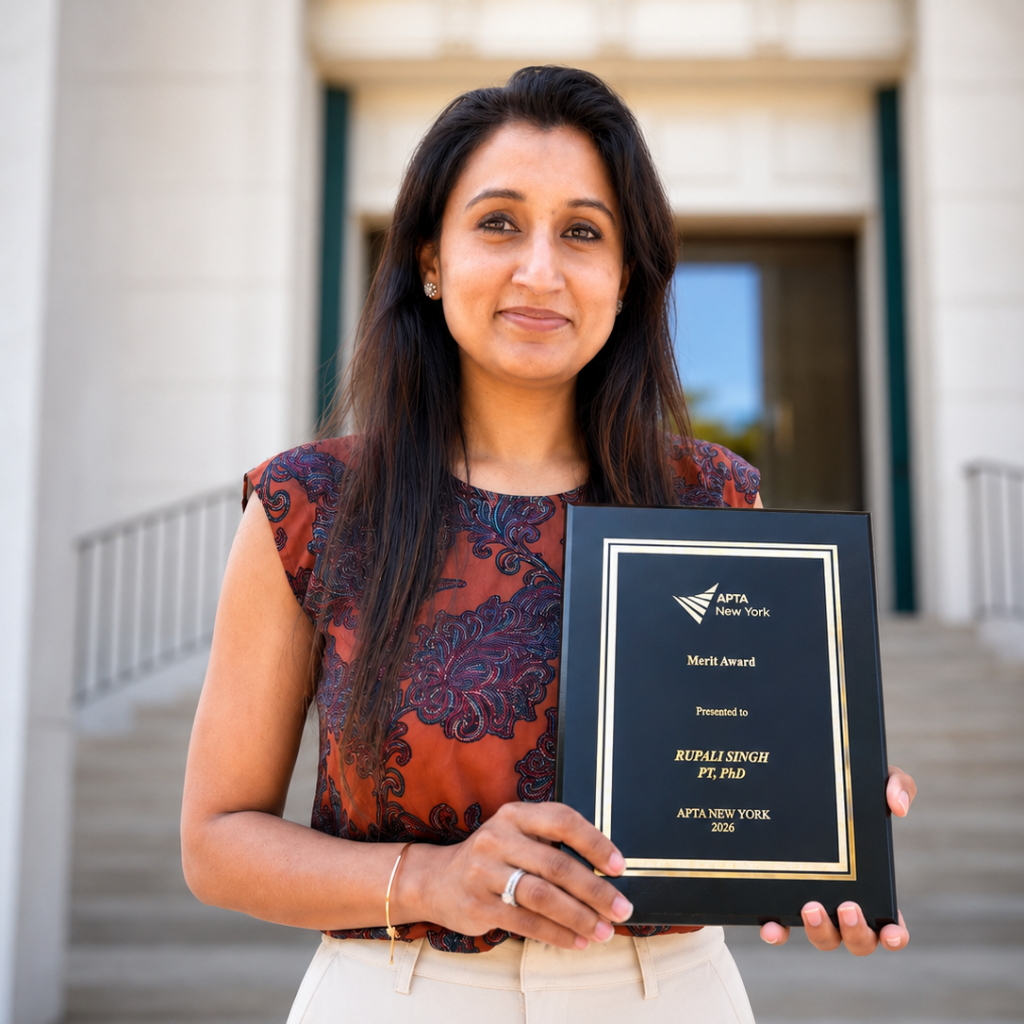
Russell Sage College Physical Therapy Professor Rupali Singh, PT, DPT, received the American Physical Therapy Association’s New York Chapter Merit Award at the APTA NY Delegate Assembly held in Saratoga Springs May 30-31, 2026.
The award recognizes a physical therapist who has made an outstanding, sustained contribution to the physical therapy profession and the New York APTA chapter. Singh was nominated by a former student, which she said made it even more meaningful.
In the following Q&A, Singh talks about the recognition, recent milestones in her APTA-funded laser therapy research for diabetic peripheral neuropathy, and her upcoming study on student success predictors.
I am deeply honored to receive the APTA New York Chapter Merit Award. I believe this recognition reflects a combination of my contributions to physical therapy education, research, mentorship, leadership, and professional service over the past 13 years.
As a faculty member at Russell Sage, I am committed to preparing future physical therapists through teaching, advising, and mentoring student research. My scholarly work focuses on improving outcomes for individuals with diabetes and diabetic peripheral neuropathy. Most recently, I received funding from the APTA to investigate the effects of low-level laser therapy on painful diabetic peripheral neuropathy.
In addition, I am involved in professional service through APTA and APTA New York, including serving on the APTA New York Diversity, Equity, and Inclusion Committee. This award is especially meaningful because it recognizes the impact of education, research, mentorship, and service working together to advance our profession.
Student mentorship has been a major part of my professional contributions and was recognized as part of the award.
I have mentored numerous DPT students in research, evidence-based practice, and capstone projects. In addition, my funded laser therapy research for painful diabetic peripheral neuropathy created opportunities for students to learn about the research process, data collection, critical appraisal of evidence, and scholarly dissemination. Seeing students develop into confident clinicians and scholars is one of the most rewarding aspects of my career, and I believe mentorship is one of the most meaningful ways we can contribute to the future of our profession.
It was a complete surprise! I was nominated by a former student who is now a colleague, David Friedberg, PT, DPT, which made the recognition especially meaningful.
David and I continue to collaborate professionally. In fact, he co-presented the results of the low-level laser therapy study at the World Physiotherapy Congress in Japan. Seeing a student grow into a professional colleague and collaborator has been one of the most rewarding aspects of my career.
What made this recognition particularly special was knowing that it came from someone I taught and mentored. To me, that reflects the lasting impact of education, mentorship, and professional relationships within the physical therapy profession
The project has progressed very well. We have completed data collection and analysis, and shared findings at several conferences. We presented the results at the APTA Combined Sections Meeting as well as at the World Physiotherapy Congress.
We are now preparing and submitting the manuscript for publication in a peer-reviewed journal so that the findings can reach a broader audience and contribute to the evidence base for treating painful diabetic peripheral neuropathy.
Another milestone I am proud of is that I was invited by APTA New York to present the results of the study and discuss the outcomes of the funding from the organization. It was a wonderful opportunity to share how the support from APTA New York translated into meaningful research and potential clinical applications for individuals living with diabetic peripheral neuropathy.
I am excited about several projects! One area I have been working on is identifying predictors of success on the National Physical Therapy Examination within our DPT program. We recently completed a study examining academic and program-related factors associated with NPTE performance, and I am interested in expanding this work to better understand how to identify and support students who may be at risk earlier in their academic journey.
I am also continuing my research related to diabetes and peripheral neuropathy, building on the findings from the laser therapy project. There is still much to learn about effective, accessible interventions that can improve function, balance, and quality of life for individuals with diabetes-related complications.
In addition, I am developing new research focused on exercise participation and access to community-based exercise programs for individuals with chronic health conditions, particularly in rural and underserved communities. Ultimately, I am most excited about projects that not only advance knowledge but also create opportunities for student involvement and have a direct impact on patient care and health outcomes.
I would just like to say how grateful I am to receive this recognition. While the award is presented to an individual, it really reflects the support and collaboration of many people along the way — my students, colleagues, research collaborators, and the leadership at Russell Sage College, who have provided opportunities for me to grow as an educator and scholar.
I am especially proud to work at an institution that values teaching, mentorship, and scholarship.
This award motivates me to continue contributing to the profession through education, research, and service, and I am excited to see what the next chapter brings for both our students and our program.